
The Romance of the Forest
The Gothic novel The Romance of the Forest by Ann Radcliffe is written in archaic 18th-century English, when forms of address equivalent to 'thou' and 'you' still existed separately
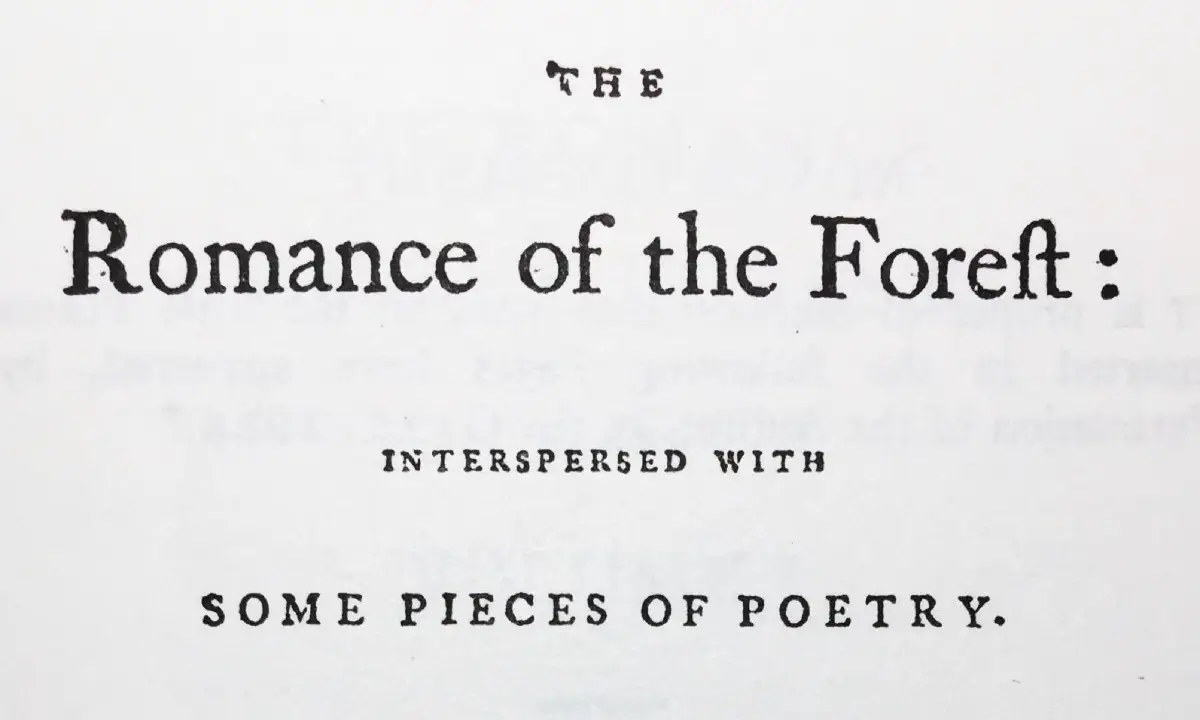

I'm currently reading Ann Radcliffe's novel The Romance of the Forest, written in 1791. I felt like diving into the classics of English Gothic fiction.
At first it was hard going, but now I can't put it down, even though I'm still reading rather slowly.
The plot is about the unfortunate orphan Adeline who, fleeing from danger, finds herself in a remote forest, among the ruins of an old abbey…
Imagine a night: outside the window a storm is roaring, thunder shakes the walls. Adeline notices that the tapestry in her room is moving, and behind it there is a secret door. Curiosity overcomes fear, and she steps into the darkness, where she finds a rusty dagger and an old manuscript. With trembling hands she unfolds the papers, trying to read a dreadful secret of the past… and at that very moment her lamp goes out. Darkness. Silence. And someone's footsteps. 🕯️😱
Eighteenth-century English is very difficult - lots of unfamiliar words, sentences are built differently - you really have to recalibrate your "reading optics".
It's hard to fight your way through archaisms like hither (here), yonder (over there), or heinous (horrible), as well as 'tis, thy, o'er… 😑
I've always liked discovering linguistic curiosities, and there are plenty of them here, for example:
-
The verb "suffer" used in the sense of "let" - for example "suffer me to go". I'm stealing that one.
-
"features" in an old-fashioned sense: "forcing a smile upon her features". Today English speakers wouldn't talk about facial features here; they'd just say "she forced a smile".
-
"what mean you, sir" - who talks like that? Today it would be "what DO you mean, sir?"
-
"At supper the Marquis was less gay than usual" - wait, less gay than usual? 😁
Of course, gay used to mean something like cheerful, so it's: "At supper the Marquis was less cheerful than usual." -
"yet it was long ere" - ERE?? Ah, so: yet it was long before.
And so on…
But the most interesting one:
"You was speaking of the Marquis…"
Not you were, but you was!
This is not a mistake. In earlier English there was a distinction between informal thou and formal you, not just a universal you as today.
Words like thou were used for close or intimate address, while you or ye were used for formal or plural address.
Thou - you (singular)
Thee - you (object)
Thy - your
Thine - your (before a vowel)
Ye - you (plural)
How about this:
- thou art (you are)
- thou hast (you have) - basically Thou, thou hast, thou hast mich 😆
- thou dost (you do)
- thou speakest (you speak)
Later, you pushed out thou, ye, and thee, and English lost the distinction between informal and formal "you".
Everyone is just you.
Your boss - you.
Your dog - you.
The Queen - you.
Many people who have lived in Britain for decades don't even realize that modern English addresses everyone using only this single "you".
What's interesting is that this replacement seems to have happened across all major English-speaking countries - from America to Australia - even though these countries were discovered and colonized at a time when thou was still actively used 🤔